
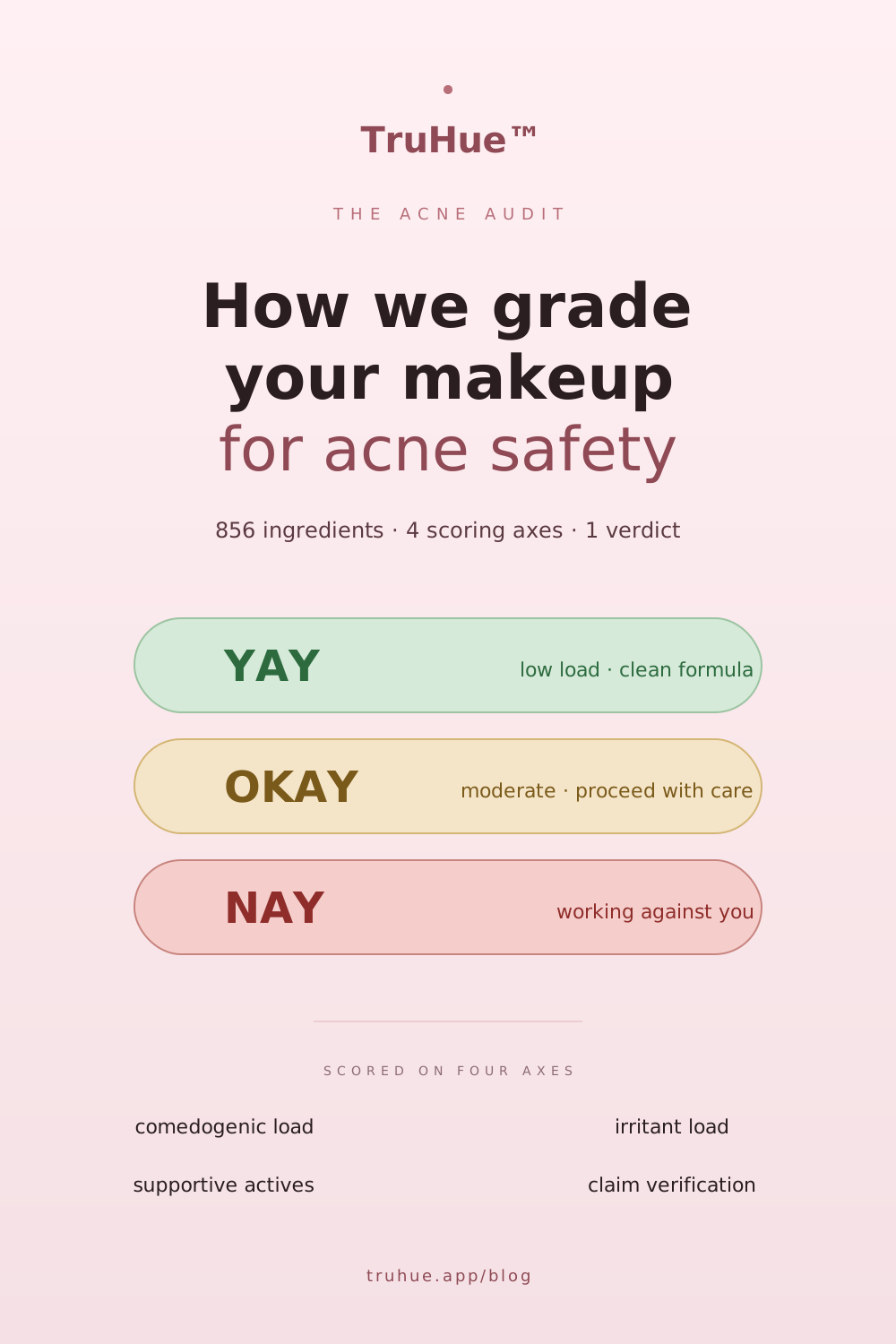
856 ingredients. Four scoring axes. One verdict: YAY, OKAY, or NAY.
You've probably seen "non-comedogenic" on a foundation label and wondered what it actually means. Here's the short answer: nothing, legally. The term isn't regulated. Any brand can print it. No one checks.
TruHue checks.
When you scan a product in the app, the acne-safe screen runs behind the same YAY / OKAY / NAY verdict you already know from color scoring — but this time it's grading the formula against an 856-ingredient comedogenic database. Here's how that works, start to finish.
Quick Answer
TruHue scans every ingredient in a product's INCI list against a curated database of 856 comedogenic and irritating compounds.
→ Score any product for your season — free
What the audit measures
Two things get conflated in beauty marketing that are actually different problems for acne-prone skin. TruHue separates them.
Not sure which season you are?
Take the free color analysis quiz — 2 minutes, no email required. Then every product in this post gets scored for your palette.
Take the Free QuizComedogenic load is about pore-clogging — ingredients that physically block the follicle and create the conditions for a comedone (blackhead or whitehead). These are measured on the Fulton scale, a 0-to-5 rating system based on decades of ingredient-level testing.
Irritant load is about inflammation — ingredients that don't clog pores but trigger redness, swelling, or papules that look like acne. Fragrance, alcohol denat., essential oils, and certain preservatives fall into this category. If your breakouts look more like angry red bumps than classic whiteheads, irritants are probably part of the picture.
The audit measures both. Separately.
FREE DOWNLOAD
Free: 30-Page Color Analysis Guide
Undertones, all 12 seasons, full makeup breakdowns — everything in one guide. Drop your email and it's yours.
No spam. Unsubscribe anytime.
The four axes
Axis 1 — Comedogenic load
Every ingredient in the product's INCI list gets checked against the 856-ingredient database. If there's a match, the ingredient's Fulton rating (0 to 5) gets multiplied by a position weight based on where it appears on the label.
Not sure of your season yet? Take the free color quiz — it takes about 2 minutes.
INCI lists are ordered by concentration — the first ingredient is the highest concentration, the last is the lowest. Position matters:
- Top 30% of the list — weight multiplied by 3
- Middle 30% — weight multiplied by 2
- Bottom 40% — weight multiplied by 1
An ingredient rated 3/5 at position #4 contributes more to the score than the same ingredient at position #28. This is the audit's way of approximating concentration without seeing the actual percentages (which brands don't disclose).
Two hard-fail rules override everything else:
- Any 5/5 ingredient in the top 30% of the list — automatic F
- Any 4/5 ingredient in the first five positions — automatic F
A hard fail means it doesn't matter what else is in the formula. A 5/5 ester as a base ingredient poisons the grade.
Axis 2 — Irritant load
Counted and position-weighted the same way as comedogenic load, but tracking a different set of ingredients: fragrance (parfum), alcohol denat., menthol, peppermint, eucalyptus, camphor, citrus essential oils and their derivatives (limonene, linalool), certain preservatives (methylisothiazolinone, formaldehyde releasers), and sodium lauryl sulfate.
One important distinction: fatty alcohols — cetyl alcohol, stearyl alcohol, cetearyl alcohol — are NOT flagged. They're a different chemical class entirely. If you've been avoiding products that say "alcohol" anywhere on the label, you've been filtering out ingredients that are actually fine for your skin.
Axis 3 — Supportive ingredients
Not everything on the INCI list is a penalty. Some ingredients actively help acne-prone skin:
- Regulated actives — salicylic acid, niacinamide, azelaic acid. If any of these appear anywhere in the formula, the grade gets an "active buyback" — one grade bump (D becomes C, C becomes B). This is why a product with a moderate comedogenic load can still earn a decent grade if it contains a real acne-fighting active.
- Hydration without clogging — glycerin, hyaluronic acid, panthenol. These help skin barrier function without contributing to pore congestion.
- Barrier repair — ceramides, allantoin, centella asiatica, madecassoside.
- Sebum control — zinc PCA.
Bonus weight if these appear in the first 15 ingredients.
Axis 4 — Claim verification
Brands make claims. TruHue verifies them against the actual INCI list.
- "Non-comedogenic" → verified only if the comedogenic load is 6 or below
- "Oil-free" → verified only if no esters from the database rated 3 or higher are present
- "Fragrance-free" → verified only if no fragrance, parfum, or essential oil entries appear
- "Mineral-based" → verified only if titanium dioxide or zinc oxide is a primary active
If a claim fails verification, the app flags it. You'll see what the brand says and what the ingredients say — side by side.
How grades work
| Grade | What it means |
|---|---|
| A / A+ | Low comedogenic load (3 or below), zero irritants in the top 30%. A+ adds two or more supportive ingredients in the first 15. This is as clean as a formula gets. |
| B | Moderate comedogenic load (4 to 9), at most one irritant flag. Wearable for most acne-prone skin. |
| C | Higher comedogenic load (10 to 18) or two irritant flags. Proceed with caution — some skin handles it fine, some doesn't. |
| D | High comedogenic load (above 18) or three or more irritants in the top 30%. If you're acne-prone, this formula is working against you. |
| F | Hard fail. A 5/5 ingredient in the top 30%, or a 4/5 in the first five positions. The base of the formula is structurally problematic. |
The active buyback can bump a grade one step. A product graded D on comedogenic load alone can earn a C if it contains salicylic acid, niacinamide, or azelaic acid. The buyback can't override a hard fail — an F stays an F.
What the audit doesn't do
Transparency matters. Here's what the audit can't tell you:
It can't predict your specific skin. Some people break out from products graded A. Others wear D-grade products for years without a single comedone. The grade is population-level guidance based on ingredient properties — not a personalized guarantee.
It can't see concentrations. INCI lists give order, not percentages. Position weighting is the best proxy available, but it's still a proxy. An ingredient at position #3 could be 15% of the formula or 5% — you can't tell from the label.
The Fulton scale is old science. Most of the comedogenic ratings come from research conducted in the 1970s and 80s using rabbit-ear testing models. It's the most comprehensive public dataset available for individual ingredients, but final-formula behavior in human skin isn't perfectly predicted by ingredient-level data.
It doesn't cover every ingredient. The database has 856 entries. Some INCI lists contain ingredients not in the database. When coverage drops below 30%, the app returns "Insufficient Data" instead of a verdict — because a clean grade based on 20% of the formula isn't a clean grade. It's a guess.
These limitations are real, and they're the reason dermatologists exist. If your derm gave you a non-comedogenic product list, scan those products in TruHue and cross-check what they flagged. The audit and your derm are answering different versions of the same question — using both gives you a fuller picture.
Acne-safe vs. clean — two different audits
TruHue runs two separate screening systems, and they measure different things:
The comedogenic + irritant screen (the Acne Audit) checks whether a product is likely to clog pores or trigger inflammation. A product can be paraben-preserved, contain synthetic colorants, and still get a YAY for acne safety — because parabens don't clog pores.
The clean score checks for a different set of concerns: parabens, sulfates, formaldehyde releasers, phthalates. A product can be 100% "clean" and still get a NAY for acne safety — because coconut oil is natural, botanical, and rated 4/5 comedogenic.
If you see both scores on a product page, they're answering different questions. Don't average them. Read them separately.
How to use this
Drop any foundation, blush, bronzer, primer, concealer, or setting powder into TruHue. You'll see the acne-safety grade, the specific ingredients flagged, their positions on the label, and the irritant summary — all in about three seconds.
If you're shopping in the store, scan the barcode. If you're shopping online, search the product name. The audit runs against the same 856-ingredient database either way.
By Claudia + Liv, TruHue
Honest makeup matching. Made by a mom and her daughter, in Oklahoma.
More from The Acne Audit
Frequently Asked Questions
How does TruHue's acne audit work?
TruHue scans every ingredient in a product's INCI list against a curated database of 856 comedogenic and irritating compounds. Each product is scored on four axes — comedogenicity, irritation, fragrance load, and silicone occlusion — then given an overall letter grade from A (safest) to F (most problematic).
Is the acne audit the same as a \
No. Clean beauty and acne safety are two different audits. Clean beauty focuses on ingredients like parabens, sulfates, and synthetic fragrances. The acne audit specifically targets ingredients that clog pores or irritate acne-prone skin — a product can be \
How many ingredients does TruHue test against?
TruHue's acne audit database contains 856 ingredients with known comedogenic or irritation ratings, sourced from dermatological research and INCI databases.
Want to try these products?
Shop on Amazon →TruHue may earn a small commission at no extra cost to you.
Keep exploring
- How to check any product in store
- Free comedogenic ingredient checker
- Bronzer acne audit
- Why color analysis apps disagree
- Best color analysis apps 2026
- The wrong lipstick that started it all
- American Academy of Dermatology — Acne (external)
- Comedogenicity (Wikipedia) (external)
- Check any ingredient list — free comedogenic checker (tool)
Shop the products in this post
Some links in this post are affiliate links. When you shop through them, TruHue earns a small commission at no cost to you — it’s how we keep the app free.
Take TruHue Shopping With You
Scan any barcode in the store and see your YAY, OKAY, or NAY score before you buy. Free on the App Store.
Download the App →Beta is open
Scan any foundation, blush, bronzer, primer, concealer, or setting powder. The acne audit grades the formula in three seconds.
Be in the first wave →